A bit on the wild side of poinsettia
- jjvanm
- Dec 20, 2025
- 3 min read
Published December 20, 2025, in the McAllen Monitor
Story and photos by Anita Westervelt, Texas Master Naturalist
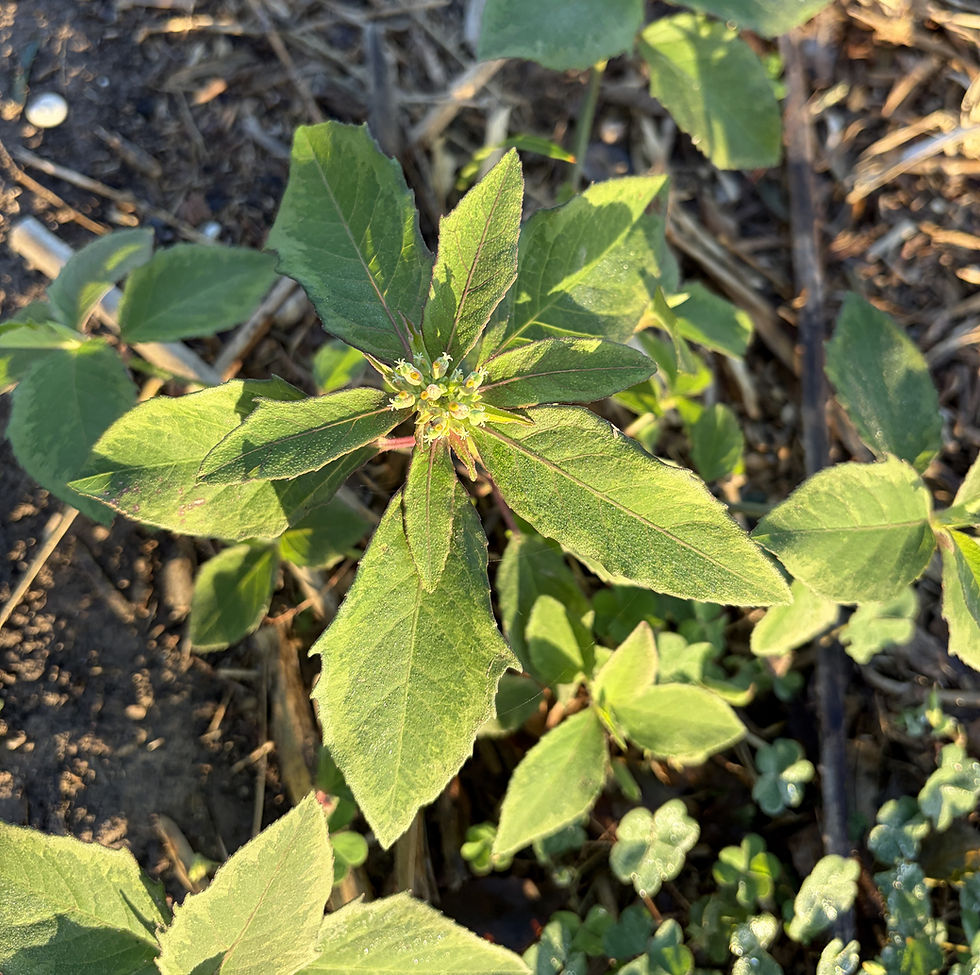
Sometime in November, there was more to do than keep the yard as neat as the neighbors. In our defense, the grass wasn’t growing much. What was popping up all over the yard was wild poinsettia, Euphorbia heterophylla. I began photographing their development in hopes of writing a Christmas article. Without much measurable rain, though, the plants were not looking good.
Earlier this year, I had to use herbicide to help eradicate an out-of-control, invasive plant in a couple of sections of our yard. Warnings on the label noted that it may take a few months before anything would grow; that warning proved to be true.
Surprisingly, several months later, by November, the first plants to emerge at the edge of the dead zones were the native wild poinsettia. As a Texas Master Naturalist, I thought it significant and apropos that a native species would initiate the rejuvenation.

To be fair, the wild poinsettias were abundant everywhere I looked: in the middle of the lawn, adjacent to straggler daisy, oxalis and other irritating ubiquitous native plants, even in the cracks of the pavers, the stone steps and along the terracing stone. Eventually, a glorious half an inch of rain helped all the wild poinsettias begin looking green and vibrant. I began a nearly daily vigil to get the best photos.
And then one morning, while searching for a perfect flower head to try and photograph the tiny blooms or find the green bracts finally showing a hint of red, what I didn’t see was mystifying. The tops – the leaves and flowerheads – of the taller stems were gone. All that was left were hollow stems sticking out at angles on the multi-stemmed plants.


As my husband and I debated what could possibly have caused the massive theft of plant tops, we spied the field camera. And the proof was in the black and white night photos: deer chomping the leafy heads of the wild poinsettia that had been earmarked to feature in my December story.

Many wild poinsettia references mentioned that most mammalian herbivores avoid the plant because it leaks a toxic milky, latex-like substance when snapped or clipped. A few field guides say white-tailed deer occasionally eat it. Searching the Internet, a brief AI-generated statement claimed “. . . an anecdotal report of deer heavily grazing on Euphorbia heterophylla plants overnight in a specific location.” And that’s what happened here. According to the field camera, the deer feasted over the course of several nights.
Regardless the deer eating the tops, I may have had a long wait to find crimson bracts. According to Wikipedia, wild poinsettia often loses its color when it grows wild as a weed, which is what I had allowed in our yard.

Wild poinsettia is sometimes cultivated for its miniature poinsettia-like appearance. It may be something to consider allowing in a pollinator garden should a few of them arrive as volunteers. They can bloom in all seasons. The flowers produce large amounts of nectar and attract bees, wasps and flies. Plants can grow from 11 to 30 inches tall. The leaves of the plant have variable shapes within and between populations.
While the plant has a propensity for robust self-propagation, doves, quail and sparrows feed on the seeds. The fruits are small, three-lobed capsules. When they mature, they explode and shoot the seeds some distance from the parent plant, allowing prolific security for the continuation of the species.
Wild poinsettia has a good many common names: dwarf poinsettia, Japanese poinsettia, Mexican fireplant, fire on the mountain, painted euphorbia, painted spurge, painted leaf, fiddler’s spurge – even milkweed.
Texas has approximately 31 species of Euphorbia. Along with wild poinsettia, other delicate and attractive Euphorbia likely to come up in gardens uninvited in the Rio Grande Valley are graceful spurge, Euphorbia hypericifolia; painted leaf, Euphorbia cyathophora; eyebane, Euphorbia nutans; matted sandmat, Euphorbia serpens; and prostrate sand mat, Euphorbia prostrata.
- 30 -