


Anita’s Blog – Don’t Be Afraid After Dark

Tarantulas can take up a defensive posture. A sting from a (local native) scorpion is similar to a bee or wasp sting. Snakes are cool to the touch and solid feeling, not clammy, slimy or slithery. You can safely hold a cockroach – if you really want to.
How do I know these things?
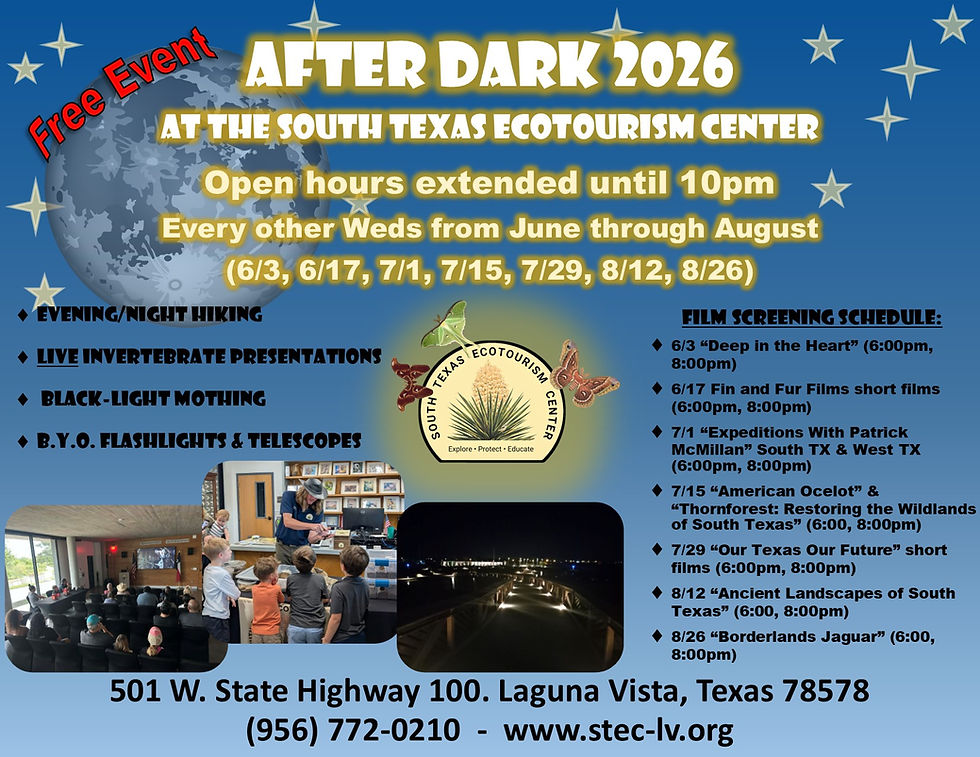
By visiting an After Dark night, a free summer event at South Texas Ecotourism Center at Laguna Vista. 501 W. State Highway 100. 956-772-0210. www.stec-lv.org
There are two After Dark Wednesday nights left this summer: August 12 and August 26. You won't want to miss out. The Center extends their hours to 10 p.m. for their After Dark events.
What you can expect:
Matthew Schalk, Educator and Ecosystem Specialist at STEC, sets up his special collection of live critters. Matthew can talk at length about the interesting creatures in his Invertebrate Presentation and answer just about any question kids and adults might happen to ask. Some of his species are native to the Rio Grande Valley, some are from the Trans-Pecos region of West Texas. A couple of others? You'll have to ask him.
Matthew knows how to safely hold critters and will instruct those curious enough to safely hold a big, furry tarantula or a small Texas snake, like the gray-banded kingsnake, Lampropeltis alterna.


I have been fascinated with snakes since I was a child, but never felt the need to hold one, until last month at Matthew’s presentation. Ok, the snake was really small and friendly. I held the checkered garter snake, Thamnophis marcianus. I’m glad I did. It helped me in a way I didn’t expect.
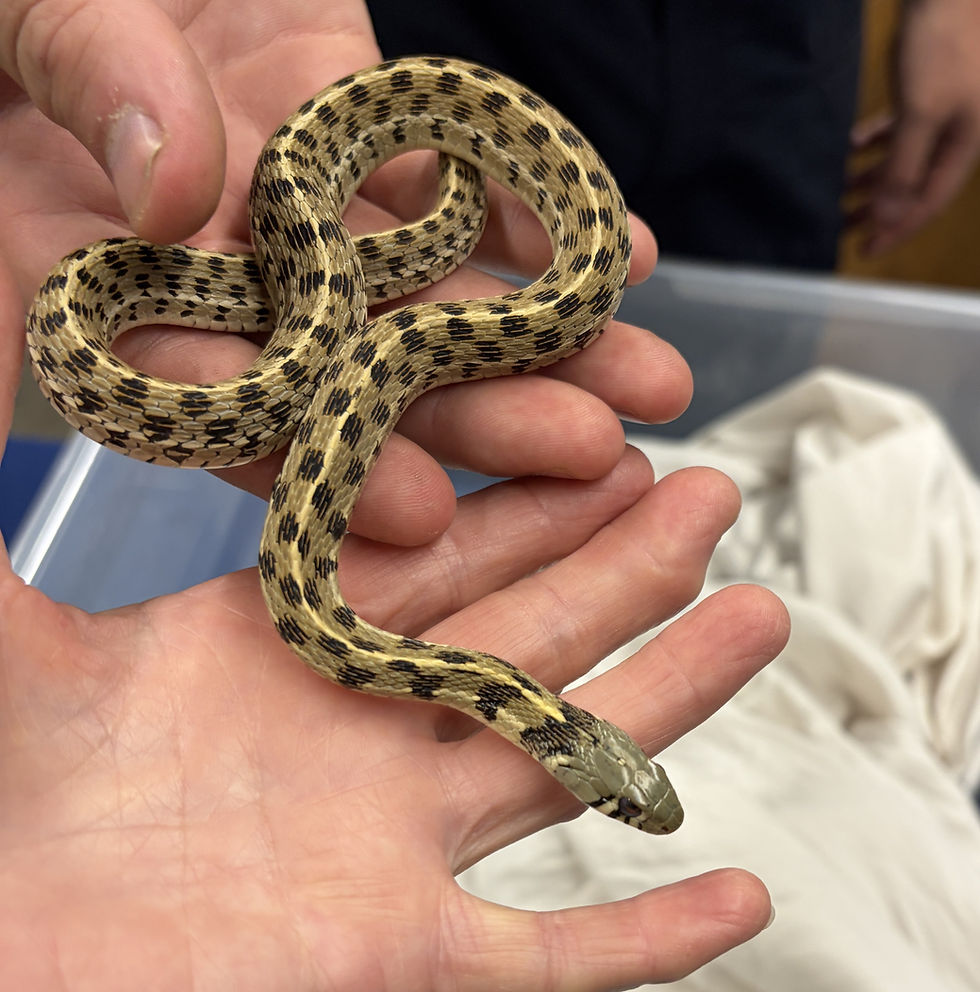
The following week, one of our cats was watching a small Texas Patch-nosed Snake, Salvadora lineata – in the house. And now that I was an expert snake handler, I was able to calmly pick up the snake and take it outdoors to safety (after I snapped a quick photo, of course). In the past, I would get a broom and a box or dustpan and (not easily) try to relocate a snake – amongst a few unhelpful squeals and backward jumps. By the way, snakes are faster than they look, even really small ones.

Just as a caution, don’t try any of the activity depicted in these photos at home; check out Matthew’s Invertebrate Presentation at the After Dark events first. Wild animals are supposed to be wild. Except for trained field biologists, licensed collectors and professional educators like Matthew, the general public should hold no expectations that a wild animal will become non wild, even if it appears docile.

Presentations such as Matthew’s during events at STEC and events at other nature parks are important because they allow the public close viewing of nature along with knowledgeable and safe information.
Here’s what else you can look forward to at STEC’s After Dark:
Trivia you may never have thought about:
I sometimes describe animals in my stories, like the ancient song of the cicada, or an alligator, as a prehistoric ambush predator reptile or a prehistoric, armored armadillo. Interestingly, there are correct scientific definitions about critter ancestry.
In the animal kingdom, prehistoric and ancient differ mainly by their timeline relative to human writing, according to a quick Google search:
Prehistoric animals lived before written human history (millions to thousands of years ago, specimens are known via fossils, bones and geological traces rather than human observation.
Ancient animals refer to real species that coexisted with early human civilizations and recorded through human artifacts, texts, hieroglyphics and ancient artwork.
Examples of Ancient creatures: armadillos, cicadas
Armadillos share a direct family tree with massive prehistoric relatives (some as big as a car), but present-day armadillos are ancient, not prehistoric – and a lot smaller.
Our modern superb dog-day cicadas are ancient, although their ancestors are prehistoric, having first appeared in fossil record over 200 million years ago, meaning early relatives sang alongside early dinosaurs.
Scorpions, tarantulas, snakes and cockroaches are modern day examples of prehistoric creatures you can see at Matthew’s After Dark Invertebrate Presentation.
Examples of other prehistoric creatures include lizards, crocodiles, alligators, frogs, toads, jellyfish, beetles, bees, sharks, horseshoe crabs, sea stars, lobsters, and salamanders.
Cockroaches made it through the Great Dying period between the Permian and Triassic periods. They were one of the most dominant species during the Carboniferous period about 360 million years, or 112 million years before the dinosaurs, when they used to be about twice as big as their current form, according to Blueplanetaquarium.com/blog.

Most scorpion species glow fluorescent blue or blue green under an ultraviolet (UV) light.
Fossilized scorpions can still glow under a black light, according an online quickread in Kids Discover.
The striped bark scorpion, Centruroides vittatus, is the primary and most frequently encountered scorpion species in the Rio Grande Valley and throughout Texas.
Photos below: From left, The Asian Forest Scorpion, Heterometrus sp., without fluorescence from a UV light as in the lead photo at top. Middle and right photos are of Diplocentrus diablo scorpion. The species has no common name, however scorpions within the genus Diplocentrus are often referred to as Toothed Scorpions. They are not particularly common, and in the Rio Grande Valley, they are only found in Starr County, according to Matthew. (Photos by Anita Westervelt)
Tarantulas need to eat only once every one to two weeks; in the wild, when food is scarce, they can go months without feeding.
In Texas, tarantulas primarily eat large insects like crickets, beetles and grasshoppers, June beetles, ground beetles, cicadas and caterpillars.

- 30 -


