


April is Native Plant Month in Texas
– Celebrate the unique stature of Spanish dagger

Published April 4, 2026, in the McAllen Monitor
Story and photos by Anita Westervelt, Texas Master Naturalist
Spanish dagger, Yucca treculeana, may be the perfect plant: drought- and heat-tolerant, handles occasional freeze to five degrees Fahrenheit, maintenance-free, slow-growing in full sun and can live 50 years, all the while providing a unique sculpture in the landscape.
My personal experience with a stately Spanish dagger was an unexpected stab to the top of my head by a poison dagger whilst I was atop my riding lawn mower. My protective gear provided ear and face protection; it did not extend to the vulnerable exposed top of my head.
Most textbook descriptions of Spanish dagger quickly mention rigid three-foot, sword-shaped leaves with sharp tips. In reality, the word dagger or lance more truly describes this garden bayonet-like weapon.

Previous owners of our property allowed a Spanish dagger to grow too close to an old mesquite tree. By time we lived there, the Spanish dagger was some eight feet tall and multi-branched. Not happy with growing into the boughs of the mesquite, it leaned, seeking the light, I suspect, which caused some of its razor-sharp leaf ends to be a danger, especially disguised amongst leafy branches of the tree.

Spanish dagger leaf tips contain steroidal saponins, which are mildly toxic. A stab from a razor-sharp yucca tip can cause immediate pain and the toxic sap may cause an inflammatory reaction. The plant is best viewed from a distance. That said, all is forgiven when the first creamy white, purple-hued bloom stalks begin poking through those protective daggers.

Native from southern Texas, New Mexico, northeastern Mexico and south to Oaxaca in Mexico, it is a succulent. The trunk is thick, woody, single stemmed or branched. Leaves have a blue-green hue.
Large clusters of bell-shaped flowers begin blooming in March on plants at least three years old. It is pollinated solely by the yucca moth or there will be no fruit.

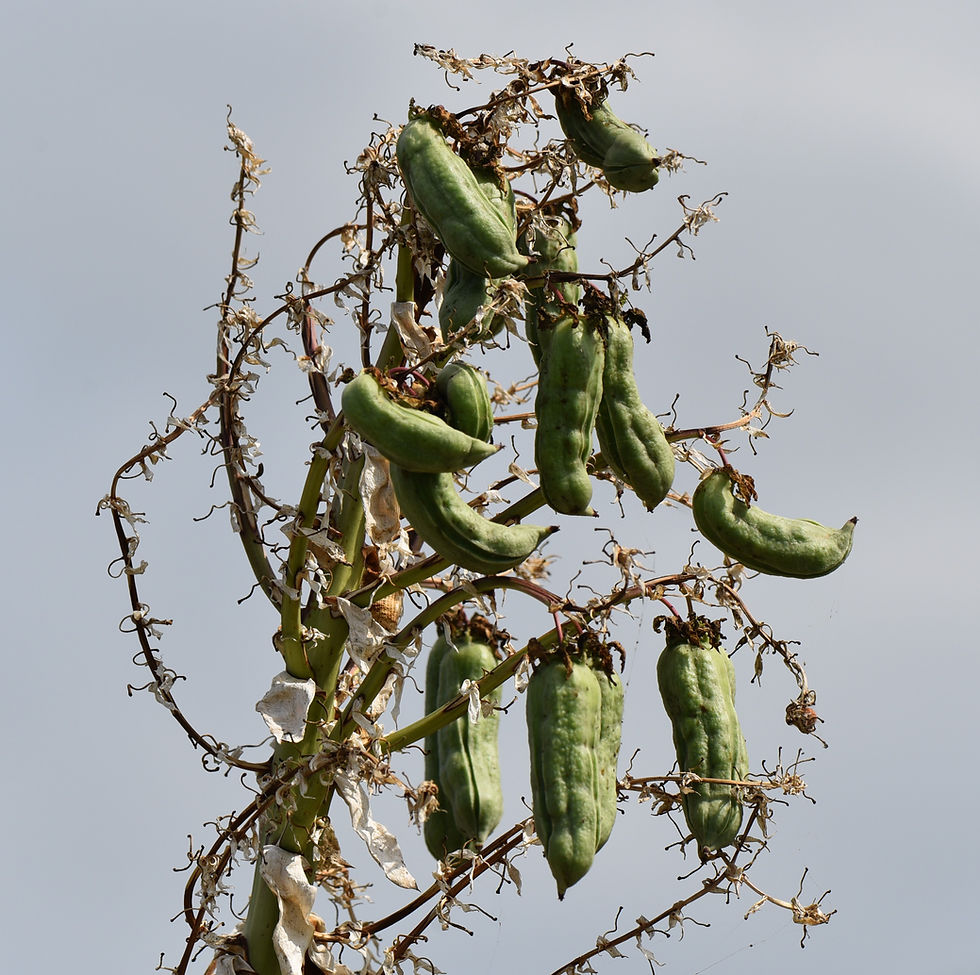
Full sun is best for healthy, upright and heavily blooming plants. Light or partial shade results in weaker growth and less flowering. The flowers attract bees, butterflies, night-flying moths, hummingbirds, and other nectar birds. Wrens and thrashers often nest in the plant’s protective, spiny leaves. Spanish dagger is a larval host for several giant skipper butterflies.
The endangered aplomado falcon frequently uses tall Spanish daggers for nesting and as a hunting perch. The falcons don’t build their own nests; they reuse abandoned nests. The outward-facing leaf-blades of Spanish dagger act as a natural deterrent against mammalian predators, such as raccoons or coyotes, that might try to reach the nest, according to a Texas Parks and Wildlife Department online paper.
The lomas of the Bahia Grande are populated with stately, old Spanish dagger trees that can be viewed from a distance along Texas State Highways 100 and 48, going into Port Isabel from Los Fresnos and Brownsville, respectively. Lomas are unique to the lower Rio Grande Valley coast and parts of adjacent Mexico. Lomas are rare, crescent-shaped clay dunes formed by wind-blown deposits that serve as critical high-ground habitats in coastal tidal flats, according to Texas Parks and Wildlife Department literature.
- 30 -


