


Purple Martins and the ruckus in the trees

Published March 21, 2026, in the McAllen Monitor
Story and photos by Anita Westervelt, Texas Master Naturalist
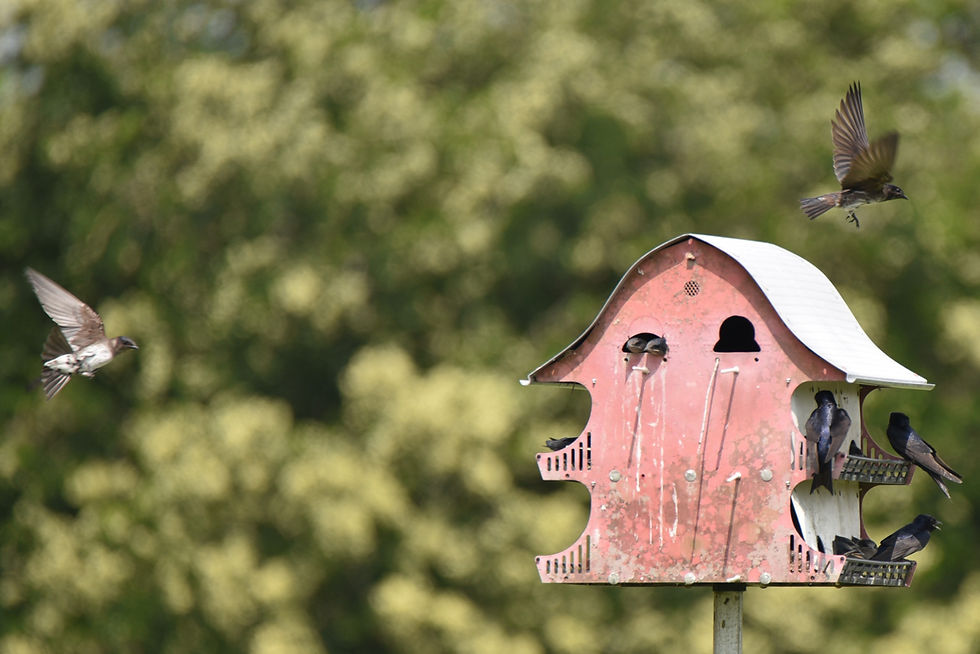
Finally! Tiny, dark, kite-shaped birds were working the airspace above the resaca. I grabbed my binoculars and checked the neighbor’s backyard martin condo to satisfy my curiosity that their purple martins had arrived.

Purple martins migrate to South America in late summer and are one of the earliest neotropical migratory birds to return to the United States. And yes, if they had a successful breeding season the previous year, the older birds return to the same house year after year. They are highly social birds, nest in colonies and are comfortable around humans. Martins returning to breed for the first time will arrive several weeks later. The earlier return of older individuals is common in species of migratory birds, according to a Wild Birds Unlimited fact sheet.
After the initial inspection on arrival day in and around the martin condo, the birds spend daylight hours feeding, not necessarily in the airspace around their base. They can travel two miles away in their search for food.

Many sources note that purple martin colonies east of the Rocky Mountains rely solely on man-made housing, speculating that the trend began when Native Americans hollowed out dried gourds to entice nesting martins – long before the Colonies were established. Wooden boxes were used in the early 1700s atop buildings. Multi-compartmented wooden martin boxes began being mass produced around 1920; popularity increased in the 1950s and modern aluminum high-rise houses were introduced in 1962.
Purple martins are our largest swallows. They perform swooping aerial acrobatics – but not for our entertainment. They are opportunistic aerial feeders, hawking flying insects at altitudes higher than other swallows, often exceeding 150 feet and higher. Their diet is nearly 100 percent flying insects and quite varied, which results in their creative aerial show. Their diet includes beetles, butterflies, cicadas, bees, damselflies, dragonflies, house flies, grasshoppers, crickets, leafhoppers, hoverflies, caddisflies, spiders, katydids, mayflies, crane flies, midges, moths, stinkbugs, wasps, even flying fire ant queens.
Mosquitoes are not their main diet as was once purported, possibly to promote sales of residential purple martin housing to would-be hobbyists. Mosquitoes are not out during daylight hours when martins actively feed and are generally too low to the ground and in dense vegetation where martins rarely fly.
I spent last summer enjoying the neighbor’s purple martin families and their daily aerial show. While their martin condo was full of nesting activity, our tallest palm tree at the resaca edge was just as busy, having been selected by our resident grackles for their nursery. I’m not sure how many grackle families tended their chicks – a lot. I didn’t mind; grackles are entertaining, too, with their fun antics.
One afternoon toward the end of June, a frenzied ruckus got my attention. The disturbance was in the palm that housed the grackle families, adjacent to where we had just completed building a fishing dock. I walked along the dock, straining to see what was alarming the grackles so frantically, when suddenly, a large cloud of purple martins flew over from the neighbor’s yard.
The clatter increased as the purple martins joined the grackles as they dived in and out of the palm branches, all squawking and flapping their wings at what was happening in the tree. The cacophony went on for about another minute, and then, a large, blond barn owl shot out of the foliage, gave a lumbering flap, launched into the air and flew across the resaca, briefly chased by martins and grackles before both species returned to their respective broods.
I was awed to have witnessed the purple martins answering the distress call of their neighboring grackles.
- 30 -


