Christmas senna; a winter-blooming beauty
- jjvanm
- Dec 6, 2025
- 3 min read

Published December 6, 2025, in the McAllen Monitor
Story and photos by Anita Westervelt, Texas Master Naturalist
Annually in December or early January, I attend a special Texas Master Naturalist chapter retreat that is held at a private office on a ranch near the outskirts of Pharr. The first year, I saw the hostess slip out the back door of the great room with a pair of clippers in her hand. I followed her and came face to face with a magnificent yellow blooming shrub. I instantly fell in love – and I admit, had more than a twinge of plant envy.

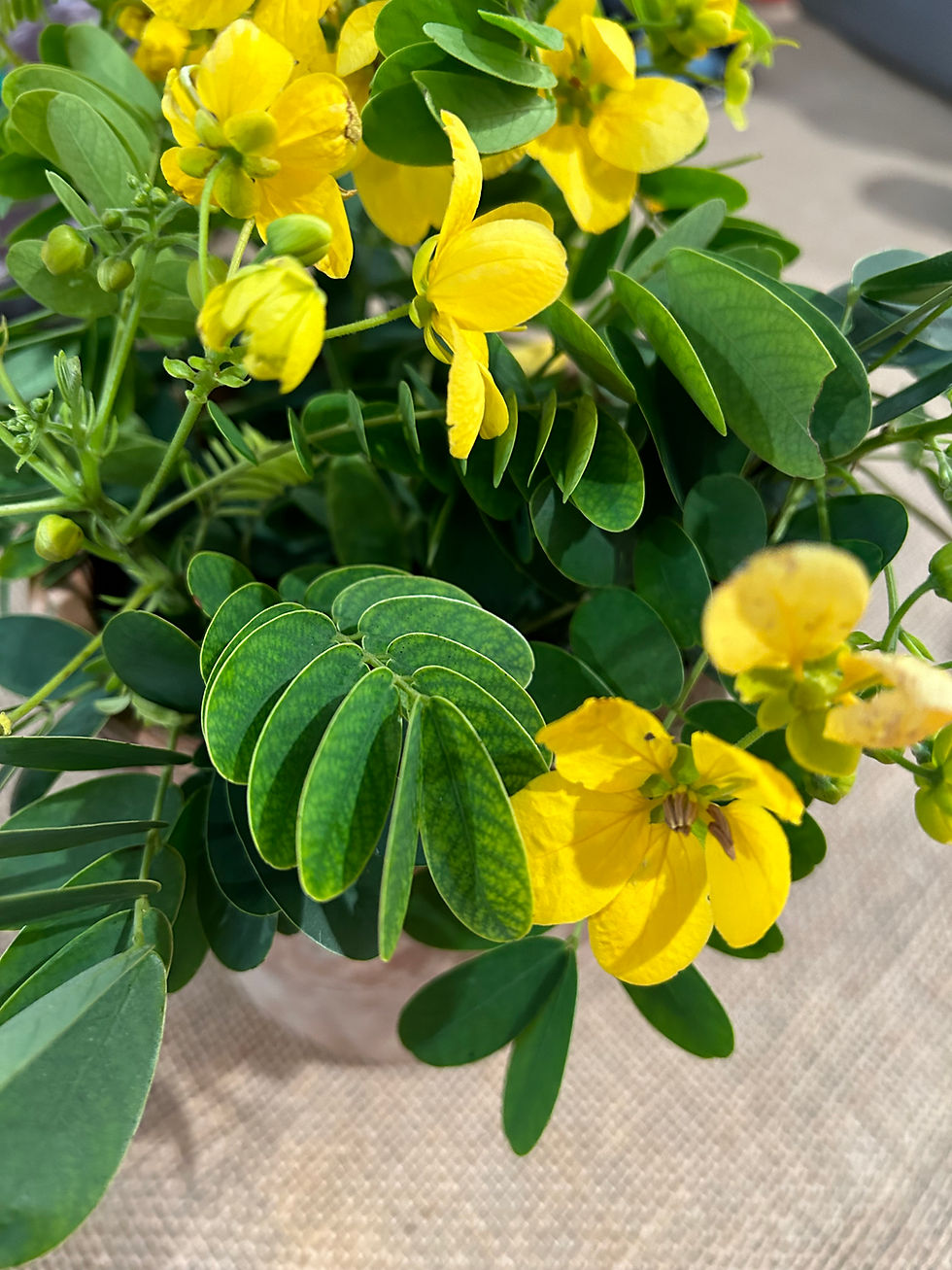
The grand shrub, I eventually discovered, is Christmas senna, Senna pendula. It blooms in the winter, hence the common name. Its bright yellow blooms aren’t exactly in keeping with traditional red and green Christmasy color schemes; however, bees, butterflies, hummingbirds and other birds appreciate the pollen, nectar and fruits of the bush no matter the color. Flower clusters make impressive impromptu table arrangements when clipped and arranged in short clay pots.
Native plant promoters recommend winter months as the time to plant native trees in the Rio Grande Valley. I encourage gardeners to consider planting shrubs, too. Shrubs are faster growing, often take up less yard space, have longer bloom cycles, provide an array of color and attract an abundance of colorful wildlife.
Christmas senna is a classic legume in the Fabaceae family with regimented deep green leaves in pairs of oval shaped leaflets with rounded tips, edged with a yellow cast. Blooms are at the leafy tips of long branches in clusters of 10 or more flowers, with bright yellow petals. The shrub goes by many common names, including winter senna, climbing cassia, smooth senna, butterfly senna, golden shower, pendant senna (because blooms appear to droop) and valamuerto, which loosely means don’t eat the seeds, they are toxic.
Regardless its common names, it is a fast-growing, erect shrub that can grow 12 to 15 feet tall. Partial shade is tolerated, but the more sun the more blooms. Be advised, Senna pendula species is native to South America. It has been widely cultivated in many countries as an ornamental because of its bright yellow flowers. It is considered an escaped species that became established in the Rio Grande Valley. Being a legume, prolific seed production is inevitable; the fruit can be six inches long and contain many small beans.

With any nonnative plant, be cautious, but it’s not all bad, Christmas senna is a host plant to cloudless sulphur, orange-barred sulphur and sleepy orange butterflies. Interestingly, I came across a snippet of information while I was researching: the caterpillars of cloudless sulphur butterflies are typically green, but they turn yellow if they primarily consume the yellow flowers.
It sounds like a tall tale, but thinking back, I witnessed that peculiarity while observing caterpillars on a Cassia fistula, a Fabaceae family tree native to Southeast Asia that was popular in the Rio Grande Valley before the big freeze of 2021. At the time, I thought all the caterpillars had, overnight, advanced to their next instar stage.
I was able to confirm the eccentricity of the caterpillar color change from a U.S. Department of Agriculture Forest Service website in an article by Evan Cole, about the cloudless sulphur butterfly; it isn’t a tall tale after all. Sulphur caterpillars eat leaves and flowers, especially those of the Senna and Cassia genus. “The color change is a form of camouflage, which lets the caterpillars blend with the plant part they are eating to avoid predators.”
Scientists call this diet-induced polyphenism, whereby an environmental cue, not genetic, determines the morph; in this case, what they’re eating or where they’re resting.
If the cooler weather encourages you to add to your garden, our South Texas Border Chapter Texas Master Naturalist website has a list of Rio Grande Valley native plant growers at this link: https://www.stbctmn.org/post/valley-native-plant-growers-nurseries
- 30 -